
Assahafa.com
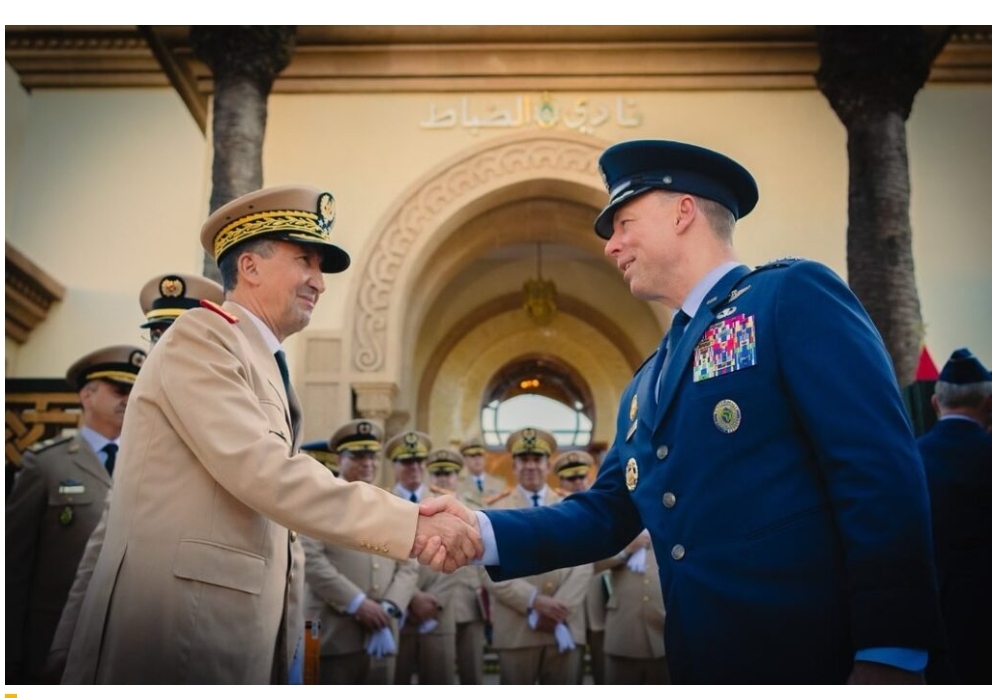
US General Dagvin R.M. Anderson opened AFRICOM’s first 2026 press briefing this week by reinforcing Morocco’s role as a strategic linchpin in upcoming military exercises, stressing the kingdom’s unique position as America approaches its 250th independence anniversary.
Speaking from AFRICOM headquarters in Stuttgart during the State Department’s Africa Regional Media Hub briefing moderated by Phillip Assis, Anderson declared: “We are excited this year as the United States approaches its 250th birthday that Morocco has been with us every step of the way as the first country to have recognized us as a nation.”
The 7th AFRICOM commander, who assumed leadership after succeeding General Michael Langley in August 2025, detailed his extensive engagement with Morocco since taking command.
“I’ve been to Morocco and Tunisia already twice, and looking – working with them on opportunities to develop their centers of excellence,” Anderson stated, hailing both Atlantic sides for establishing counterterrorism training facilities to serve as “force multipliers” across the continent.
Anderson announced African Lion 2026 will proceed in May, describing it as AFRICOM’s flagship exercise bringing together “19 African countries together with six European and then some from South America and the Middle East as well.” The exercise operates through three regional spokes in Tunisia, Ghana, and Senegal, indicating its continental scope.
Sergeant Major Garric M. Banfield, AFRICOM’s Command Senior Enlisted Leader, joined Anderson for the briefing. Both officials recently completed diplomatic missions to East Africa with Deputy Secretary of State Christopher Landau, visiting Ethiopia, Kenya, and Djibouti.
The Morocco-US military relationship traces to December 1777, when Sultan Sidi Mohammed Ben Abdallah (Mohammed III) opened Moroccan ports to American vessels, effectively recognizing the fledgling republic’s sovereignty. This evolved into the 1786 Treaty of Peace and Friendship, negotiated through Thomas Barclay and widely considered America’s oldest continuously operative treaty relationship.
Anderson reinforced the economic-security nexus during his remarks: “Security leads to stability; that stability creates opportunities for investment; and that investment creates prosperity for both African partners as well as the United States.” He detailed ongoing discussions within the US government about integrating economic and military levers more effectively.
‘The largest military event in Africa’
Meanwhile, Morocco’s Royal Armed Forces (FAR) conducted African Lion 2026 planning meetings from December 8-12, 2025, at the Southern Zone headquarters in Agadir. The exercise is scheduled from April 20 to May 8 across regions, including Agadir, Tan Tan, Taroudant, Kenitra, and Benguerir.
According to the FAR communique, the exercise aims to “improve interoperability between participating countries, strengthen operational readiness and capacity to conduct combined and joint operations, and promote regional security and stability.”
The FAR statement noted the exercise’s historical significance, declaring: “It should be noted that more than 40,000 military personnel have participated in the last five editions of this exercise, thus testifying to the commitment of our partners and the importance of this annual event, which constitutes the largest military event in Africa.”
Official releases describe the 2025 edition as involving 10,000+ troops from 50+ nations, designed to build “the ability to operate together across complex, multi-domain scenarios.”
A strategic entrance into the third century
Recurring speculation about relocating the United States Africa Command from Stuttgart has increasingly converged on Morocco as the most credible candidate – though the debate unfolds on two separate, but often conflated, layers.
The first concerns a potential relocation of AFRICOM’s headquarters itself, long criticized for being based in Germany despite its Africa-focused mandate.
In this context, Spanish media have reported exploratory studies examining Kenitra’s military base as a possible host, citing Morocco’s geostrategic position at the junction of Europe, Africa, and the Middle East, alongside its mature military infrastructure and decades-long interoperability with US forces.
Pentagon relocation criteria – reportedly centered on logistical reach, political stability, and the reliability of host-nation partnerships – consistently place Morocco ahead of alternatives.
The second layer is more sensitive: speculation that some functions currently anchored at Naval Station Rota could, over time, be re-oriented toward Morocco, not through a wholesale “move,” but via expanded forward presence and operational reliance south of the Strait. While no formal decision supports such a shift, Spain’s standing as a host has been politically strained.
This tension sharpened in October 2025, when President Donald Trump openly suggested that Spain could be expelled from NATO over its refusal to raise defense spending to 5% of GDP – calling Madrid a “laggard” and threatening economic retaliation.
The episode reinforced a broader strategic question in Washington: whether Africa-focused missions should remain tethered to European political constraints when a stable African partner is already deeply integrated into US planning.
Historically, the irony is clear. When AFRICOM was created in 2007, President George W. Bush initially favored locating its headquarters in Africa, but political resistance across the continent forced a compromise.
Nearly two decades later, Morocco’s growing role suggests that original logic has not disappeared – it has merely been deferred, and is now re-entering strategic debate in a far more favorable regional context.
Anderson’s briefing strengthened AFRICOM’s 2026 priorities, including addressing terrorist threats from ISIS and al-Qaeda affiliates while leveraging technological innovation.
The commander stressed working with “willing partners” possessing unique capabilities, positioning Morocco prominently within this strategic framework as the historic alliance enters its third century.
Source: Morocco word news