
Assahafa.com
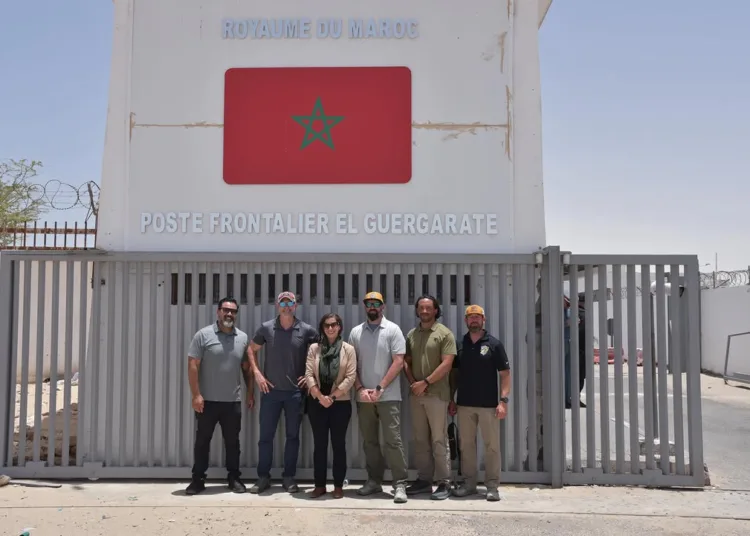
The United States Embassy in Morocco announced that a delegation from the US Mission traveled to El Guerguerat for the first time. The crossing is the sole border point between Morocco and Mauritania. The visit marks another concrete step in Washington’s expanding footprint across the Western Sahara.
In a statement posted on its official social media pages, the embassy said the delegation met with Moroccan counterparts to discuss border security cooperation, counter-narcotics and anti-trafficking efforts, and interagency coordination in the Sahara.
“For the first time, a U.S. Mission to Morocco delegation traveled to El Guerguerat – the only border crossing between Morocco and Mauritania – underscoring our shared commitment to regional security and stronger bilateral cooperation,” the embassy wrote.
The visit is the latest in a pattern of deliberate US engagement in Morocco’s southern provinces. Since Washington recognized Moroccan sovereignty over the Sahara in December 2020, the trajectory has moved steadily from diplomatic declarations to physical presence on the ground.
That shift was already visible in May, when US Ambassador Duke Buchan III made his first trip to Dakhla. He was received by Ali Khalil, the wali of the Dakhla-Oued Eddahab region. Buchan pointed to the deepwater port under construction and affirmed that it opened vast new trade and investment opportunities for the region. “The United States is keen to be part of it,” he stated.
His visit coincided with the African Lion 2026 military exercise, which for the first time deployed its humanitarian component in the southern provinces. More than 100 US military medical personnel worked alongside Moroccan teams in Dakhla, providing care to over 20,000 beneficiaries across general consultations, eye exams, and dental hygiene outreach.
Buchan used the occasion to deliver an explicit political message. “President Donald Trump has been clear in his support for Morocco’s sovereignty over the Sahara. The moment to resolve this conflict is now,” the ambassador said from Dakhla. He added: “From Tangier to Dakhla, the United States stands with Morocco.”
Washington also took a harder line on security. In May, after the Polisario Front fired projectiles at the city of Es-Smara – wounding a civilian – the US Mission to the United Nations issued one of its strongest condemnations of the separatist group in recent years. “Such violence threatens regional stability and the progress made towards peace,” the mission wrote on X.
It called the attacks “inconsistent with the spirit of the recent talks” and said the time to end the 50-year-old dispute “is now.” The condemnation marked the first time Western powers publicly called out a Polisario strike, a departure from years of silence on similar incidents.
It was a position that Buchan himself doubled down on in subsequent talks with MINURSO head Alexander Ivanko, where he warned that violence attributed to the Polisario Front had drawn “resounding international condemnation” and that continued refusal to engage in negotiations over the future of the Sahrawi people risks stalling the diplomatic process.
Earlier at GITEX Africa 2026 in Marrakech in April, Buchan had devoted a significant portion of his opening session address to the Sahara file. He said the US supports the Moroccan Autonomy Plan as a path to resolution, noting he had spent hundreds of hours negotiating with relevant parties on the plan.
He described the Dakhla deepwater port as the largest and deepest Morocco has ever built and called the economic potential in the Moroccan Sahara “unlimited.” American investors, he confirmed, were contacting the embassy and consulate nonstop to do business in the Sahara.
The diplomatic momentum extends well beyond the ambassador’s movements. In late April, US Deputy Secretary of State Christopher Landau reaffirmed Washington’s recognition of Moroccan sovereignty during talks with Foreign Minister Nasser Bourita in Rabat.
He called the Moroccan autonomy proposal “the only basis for a just and lasting solution” and said the situation could not wait “another 50 years or 150 years or 200 years to be resolved.” Landau also stressed US support for American companies wishing to invest in the Sahara.
Under Donald Trump’s second administration, Washington has been driving the political process forward. In February, the US convened quadripartite talks in Madrid, bringing together Morocco, Algeria, Mauritania, and the separatist Polisario Front, followed by a second round in Washington later that month.
Senior Advisor Massad Boulos led the US side alongside UN Ambassador Michael Waltz. The talks operated within the framework of UN Security Council Resolution 2797, adopted in October 2025, which designated the Moroccan autonomy plan as the basis for negotiations.
The intensified engagement comes as the two countries mark 250 years of ties. Morocco was the first country to recognize American independence, and the 1786 Treaty of Marrakech remains the longest unbroken treaty relationship in US history.
On the economic front, Morocco and the United States signed a memorandum of understanding on critical minerals cooperation in Washington on February 4. The agreement covers the exploration and extraction of minerals essential for energy transition, defense technologies, and advanced manufacturing.
The El Guerguerat delegation visit caps a sequence that has seen Washington pair its sovereignty recognition with a visible, operational presence across the region.
Source: Morocco word news