

Assahafa.com
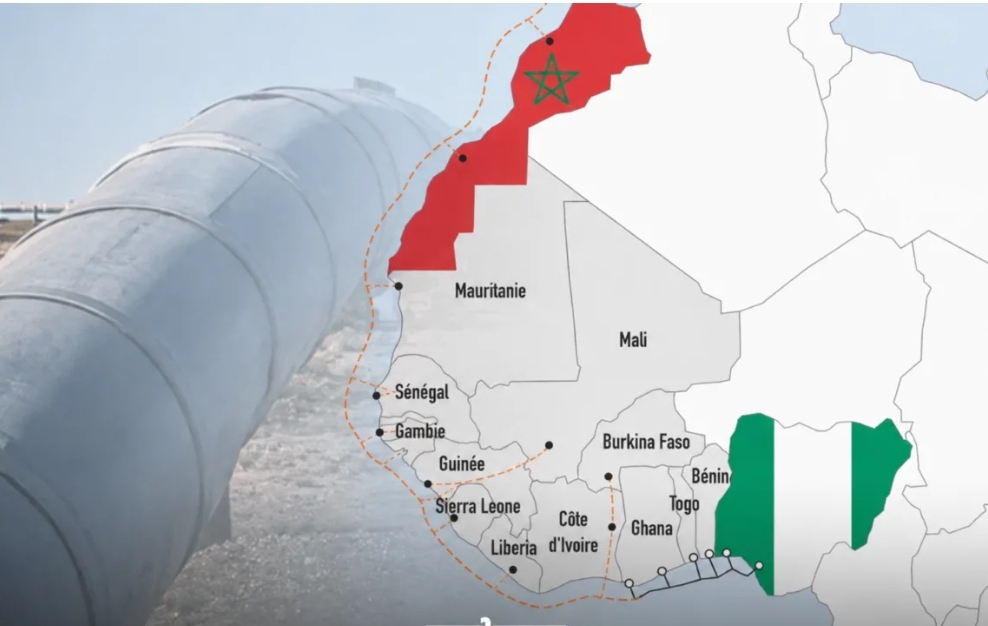
The Morocco section of the Africa-Atlantic Gas Pipeline will stretch 2,220 kilometers. It will include four compression stations, two receiving terminals, and six temporary construction camps, each housing up to 1,200 workers.
These details come from an environmental and social impact study for the pipeline’s Moroccan segment, reported Wednesday by Asharq Bloomberg. The document reveals the project’s pre-construction blueprint as it transitions from engineering toward execution.
The pipeline’s total estimated cost stands at $25 billion. It will run approximately 6,900 kilometers through 13 countries along Africa’s western coast. The project aims to connect Nigerian gas reserves to West African nations and Morocco before reaching European markets.
Of the 2,220 kilometers inside Morocco, 1,830 will run onshore and 390 offshore. The pipeline will use a 48-inch diameter, designed to meet current demand and accommodate future increases in gas volumes as production grows across transit countries.
The study identifies four compression stations along the onshore route near Boujdour, Tan-Tan, Agadir, and Safi. These stations will be spaced 300 to 320 kilometers apart, and each will occupy roughly 64 hectares. Sites were selected near ports and transport networks to ease equipment delivery. The stations’ function is to restore gas pressure over long distances, keeping flow rates steady through the pipeline’s full length.
Linking Morocco to European markets
Two receiving stations will also be built inside Morocco. The first will serve as the entry point for gas arriving from Mauritania through the offshore segment. The second, at the end of the onshore route, will connect directly to the Maghreb-Europe Gas Pipeline. This link would enable gas exports to European markets through existing infrastructure.
On the construction side, the project will use separate Engineering, Procurement, and Construction packages. Different contractors will handle different pipeline sections and stations. The approach is meant to allow work in parallel and shorten the overall timeline.
Six temporary camps will be set up along the Moroccan route. Each camp will cover approximately 300 kilometers and house between 1,000 and 1,200 workers. Facilities will include pipe storage yards and equipment maintenance workshops. Local hiring will be prioritized, with specialized training programs provided.
The offshore section within Moroccan waters will extend roughly 390 kilometers between the maritime border with Mauritania and the Dakhla area. Depths range from 15 to 100 meters. Near the coast, the pipeline will be gradually buried for about eight kilometers and protected with concrete coating, anti-corrosion layers, and cathodic protection. The operational lifespan is estimated at 40 years.
The study was prepared by a consortium of four firms: France’s Phénixa and Oréade-Brèche, the US-based CSA Ocean Sciences, and Morocco’s ZIZ GEO Consulting. It was commissioned by Morocco’s National Office of Hydrocarbons and Mines (ONHYM) and Nigeria’s National Petroleum Company (NNPC).
According to the study, a fully offshore route along the Atlantic coast was initially considered but rejected. Higher construction and maintenance costs, technical complexity, and potential damage to marine ecosystems ruled it out.
The hybrid route was chosen for its economic and security advantages and its ability to supply cities and industrial zones along the way. The path inside Morocco was adjusted to avoid populated areas and ecological reserves, maintaining at least one kilometer from sensitive habitats.
The Moroccan section falls under Phase 1B of the project, stretching from Kayar in Senegal to the connection point with the Maghreb-Europe Gas Pipeline. A final investment decision is expected in the fourth quarter of 2026. Commercial operations are targeted for the second quarter of 2031.
Diplomatic push and US interest
The study follows a strong diplomatic push behind the pipeline in 2026. In May, Morocco’s Foreign Minister Nasser Bourita and Nigerian counterpart Bianca Odumegwu-Ojukwu discussed the project by phone.
Nigeria’s foreign ministry said both countries expect to sign an intergovernmental agreement in the fourth quarter, to be endorsed by President Bola Tinubu and King Mohammed VI.
Earlier that month, ONHYM Director General Amina Benkhadra led a delegation to Washington to promote the pipeline project.
The team held meetings with the US Department of Energy, the State Department, the National Security Council, the World Bank, the US International Development Finance Corporation, and several think tanks, including CSIS, the Stimson Center, and the Atlantic Council.
Morocco’s Ambassador to the US, Youssef Amrani, noted “genuine US interest” in the pipeline and critical minerals.
Benkhadra told Reuters in April that the pipeline will have a maximum capacity of 30 billion cubic meters, with 15 bcm to supply Morocco and support exports to Europe, with first gas from initial phases expected in 2031. She also confirmed that the intergovernmental agreement would be signed this year.
Each segment is designed as a standalone system to allow early value creation. No final funding commitments have been secured yet.
Bloomberg reported in late April that ONHYM plans to launch its first fundraise for the project, the first since the agency converted into a public limited company in February, a move it said strengthens its capacity to structure partnerships and mobilize diversified funding.
A project company will be established in Morocco as a joint venture between ONHYM and NNPC to lead execution, financing, and construction.
Source: Morocco word news