

Assahafa.com
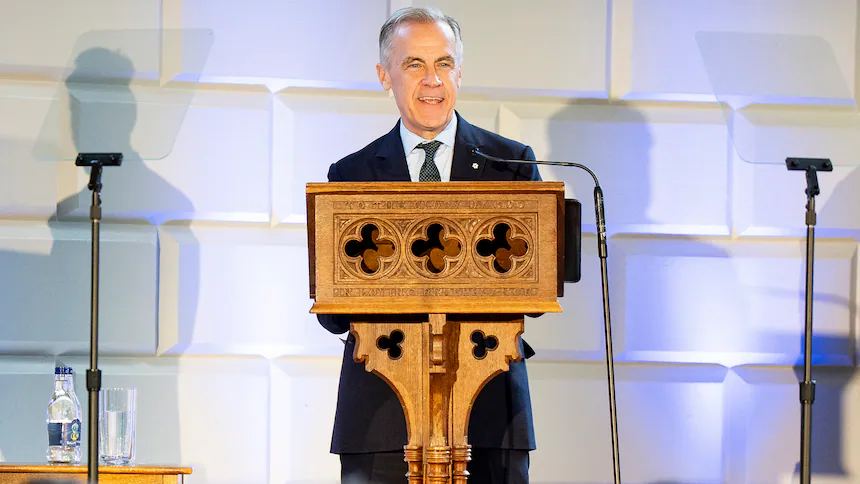
Speaking at Trinity College in Ireland last weekend, Mark Carney recalled that Edmund Burke, the influential 18th-century politician and philosopher (and an alumnus of Trinity), had once described society as a partnership between those who are living, those who are dead and those who are yet to be born.
After his prepared remarks, the prime minister was joined on stage by Alex White, a former cabinet minister in the Irish government. Recalling Carney’s landmark “tragedy of the horizon” speech as governor of the Bank of England, White observed that Burke’s quote seemed apropos of climate change, particularly as it related to the impact on future generations.
Agreeing with White’s framing, Carney noted the political problem he identified in that earlier speech: that short-term incentives can work against climate action.
“The challenge in climate and many other public policy issues,” Carney said, “[is] that doing the right thing, living up to Burke … the proof of being right or the payback is beyond your political cycle, potentially, certainly the electoral cycle, often beyond your career. Even if you’re very successful.”
As history has well shown, it can be far too easy for political leaders (and by extension, voters) to put off acting to combat climate change.
Youth, advocacy groups sue Carney government over climate rollbacks
Two days after Carney’s visit to Trinity College, an application was filed in Federal Court by Ecojustice on behalf of three young environmental activists and two environmental groups, who argue that the Carney government’s climate agenda has now put the government out of step with federal law.
“When political leaders say they are committed to climate action while dismantling the very policies needed to achieve it, young people notice because we are the ones who will be facing and living with the consequences of that,” Sophia Mathur, 19, told a news conference in Ottawa this week.
Mathur and her fellow applicants may be worried most about long-term consequences, but their litigation raises an interesting and potentially important near-term question for the Carney government.
A test of net-zero accountability
The legal challenge concerns the Net-Zero Emissions Accountability Act, legislation introduced by Justin Trudeau’s Liberal government and passed by Parliament in 2021. Modelled on similar laws in other jurisdictions, the act requires that the federal government set targets for emissions reductions, publish plans for meeting those targets and regularly provide updates on the country’s progress toward its targets.
The first of those plans was published in 2022, with the aim of reducing emissions by 40 per cent below 2005 levels by 2030. Analysis published by the Canadian Climate Institute deemed that plan to be “credible.”
But as the applicants note in their filing, federal climate policies have been significantly altered since then — the consumer carbon tax fully repealed, and a number of others adjusted or weakened. A progress report published by the Carney government in 2025 projected that national emissions could be reduced by 28 per cent by 2030. That would still be an achievement when measured against Canada’s historical failure to reduce emissions, but it would obviously be short of the official target.
Environmental groups are suing the Carney government to try and force the development of a climate plan they say will achieve Canada’s legally binding climate targets. Environmental Defence Canada’s Julia Levin called Carney’s recent decisions a ‘deeply irresponsible and cynical way to govern.’
Given that the 2022 plan is no longer operative, the applicants believe the government should be compelled to produce a new plan that is capable of achieving Canada’s 2030 target (a target that the Carney government still claims to stand by).
“We’re asking for a plan to achieve the target, not a plan to fail,” Charlie Hatt of Ecojustice said at the news conference.
(Another legal challenge, launched several years ago on the basis of Charter rights, is still working its way through the courts.)
It remains to be seen how the Carney government will respond to the application, either legally or substantively. But in a recent interview with the Narwhal, former environment minister Steven Guilbeault predicted that a legal challenge could be mounted and suggested the government might be tempted to repeal the accountability law.
If the Carney government went so far as to do that, it would no doubt attract criticism. But repealing the law would also let future governments off the hook from facing the accountability that the legislation was meant to ensure. Ministers in the current government might argue that the Trudeau government left them and Canadian climate policy in a tough spot, but they might still want to leave behind a law that with which some future Conservative government would have to contend.
Opening debate on the net-zero accountability act in November 2020, Jonathan Wilkinson held out the hope it would “depoliticize climate action” at the federal level. That might have always been too much to hope for, but the then-environment minister also argued the bill would “ensure that never again will Canada have a government like that of Stephen Harper, which established an emissions reduction target but never brought forward a credible plan to achieve it.”
In fairness to Harper, setting a target without a plan to meet it was a bipartisan Canadian tradition upheld by multiple prime ministers over many years.
More apolitically, the Canadian Climate Institute suggested in a paper published in June 2020 that, “Climate accountability frameworks can help bridge the gap between medium- and long-term goals and the policy action required to achieve them.”
Bridging the gap, one might say, between the horizon and the electoral cycle.
Carney’s view of climate policy
While the Carney government has been criticized for his changes to federal climate policy, he has not stopped talking about climate change as an urgent threat. He is not speaking like a politician who thinks he needs to play down the issue.
“Climate change is no longer a warning. It’s here,” he said at Trinity College.
He told his audience that last year in Canada “forests larger than Ireland burned in the drought and heat.”
When his Irish interviewer later turned to the climate, Carney noted his earlier argument, as a central banker, that better information and disclosure might help markets better prepare for climate change and changes in climate policy. That has not been fully realized, he acknowledged, in part because of new immediate concerns.
“The lessening of climate action is because of the affordability crisis that families are facing for a variety of other reasons,” Carney said, seemingly speaking in a global sense and not specifically of Canada. “And it means that we have to adapt our instruments.”
Power & Politics speaks to Minister of Environment and Climate Change Julie Dabrusin about the critiques and concerns surrounding Friday’s announcement, and what the minister calls ‘a really important agreement for Canada.’
One of things his government was focused on, Carney said, was “where can we have major climate returns by reducing emissions that actually help our businesses become competitive and do so in a way that doesn’t hit the pocketbook of Canadian families.”
Specifically, Carney cited an emphasis on doubling Canada’s electricity grid and using the “government balance sheet” to spread out the cost of doing so.
Clean electricity may well be the new backbone of Canadian climate policy. And federal climate policy was going to change whoever was prime minister after last year’s election.
The question now is whether the Carney government can put Canada on a credible path to net-zero and maintain the law that was supposed to help hold to account every government between now and 2050.
Source: cbc