

Assahafa.com
50 years after the Philippines and Morocco established diplomatic relations, a new book is looking much further back in time.
Published by the Philippine Embassy in Rabat to commemorate the anniversary, “A Book of Pleasant Journeys into Faraway Lands” traces connections between the two countries that stretch across centuries, long before formal diplomatic ties were established in 1975.
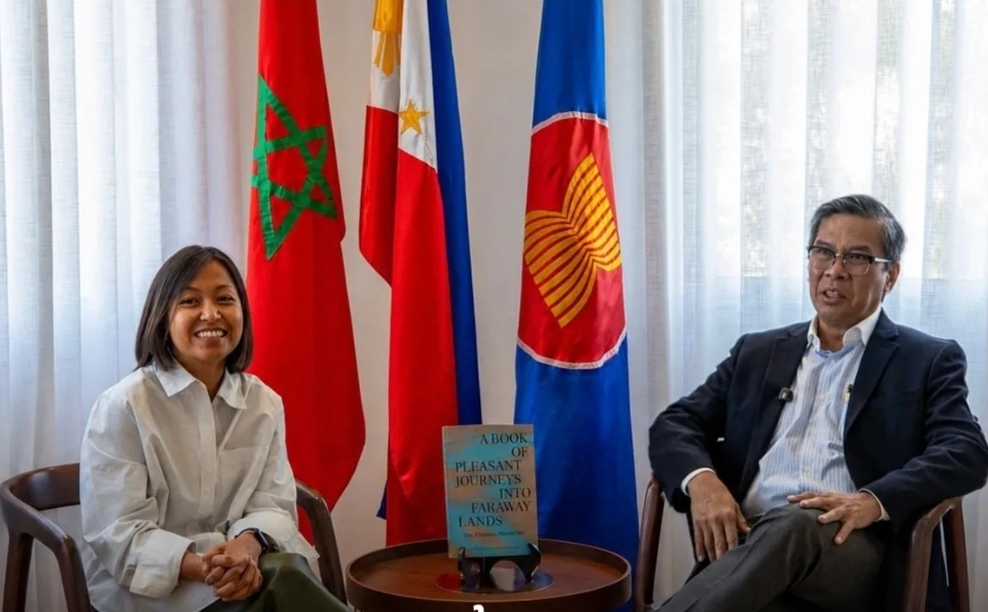
Speaking to Morocco World News, Philippine Ambassador to Morocco Leslie Baja said the project was partly driven by the embassy’s own history.
The Philippine Embassy in Rabat was closed for nearly three decades, from 1993 until it reopened in 2020.
“For most of the 50 years that we commemorated last year, the embassy in Rabat was actually closed,” Baja said. “So we deemed it very important to document the rich and the varied history of bilateral relations between our two countries.”
According to the ambassador, the research uncovered numerous historical links and shared experiences that helped create what he described as a strong foundation for the future of relations between the two nations.
The book was written by Rapunzel Acop, First Secretary and Consul at the Philippine Embassy in Morocco. She spoke of arriving in Rabat in January 2024 and receiving an unusual first assignment.
“I asked the Ambassador what my first order of business was and he asked me one thing. He said, ‘I would like you to write a book on the Philippines and Morocco,’” she recalled.
At the time, Acop knew little about the history connecting the two countries. Still, after months of extensive research in both Moroccan and Philippine archives, what began as a five-page document handed by the Ambassador eventually grew into a more than 200-page document on the legacy of the friendship between the two governments and peoples: “It took almost two years to write this book,” she said.
Acop spent considerable time at Archives du Maroc and relied on material from Maghreb Arab Press, as well as archival documents from the Office of the President in the Philippines.
From Ibn Battuta to modern diplomacy
One of the stories that stood out during her research was the account of Moroccan explorer Ibn Battuta and his encounter with the legendary Princess Urduja.
Acop noted that Filipino students learn about Princess Urduja in school and that many people do not realize the story comes from Ibn Battuta’s travels.
According to his writings, Ibn Battuta stopped at a place called Tawalisi while traveling between Southeast Asia and China and met a warrior princess who ruled a matriarchal society and refused to marry anyone who could not defeat her in battle.
For years, many Filipinos believed Tawalisi was located in Zambales, a province in the northern Philippines. The belief became so widespread that monuments dedicated to Princess Urduja were built there and the governor’s residence became known as Urduja House.
“Even our national hero, Dr. Jose Rizal, believed that Zambales was Tawalisi,” Acop said.
Later studies challenged that theory, but by then the legend had already become part of Philippine history and popular culture.
Acop said the story remains one of the strongest symbolic links between the two countries.
“We are both maritime nations. We both take to the sea,” she said, describing Ibn Battuta as possibly the first Moroccan explorer to reach that part of the world.
The book goes beyond folklore. It explores early religious and cultural links, including accounts of Makhdum Aminullah, believed to have come from al-Maghrib, or Morocco. It also examines the Philippines’ support for Morocco’s independence movement, including its advocacy at the United Nations after the exile of Sultan Mohammed V.
Building the next 50 years
The publication follows the development of bilateral relations after 1975 and looks at cooperation in trade, diplomacy, education, culture, tourism, and people-to-people exchanges.
Baja said relations have expanded steadily since both countries reestablished a diplomatic presence in each other’s capitals. He noted that economic relations have increased by around 60% since 2020, while cultural events and exchanges have helped introduce each country to new audiences.
The book also examines Morocco’s growing engagement with ASEAN and argues that Morocco and the Philippines can serve as gateways to Africa and Southeast Asia respectively.
Looking ahead, Baja said stronger political consultations, high-level visits, and deeper private-sector cooperation could help shape the next chapter of relations.
“We have established the groundwork, the foundation for stronger relations for the next 50 years,” Baja said, pointing to regular political consultations, potential business agreements, and deeper cultural exchanges.
But for him, the book is ultimately about something simpler.
“Distance will not matter if you like or love something that you would like to do,” he said when asked why relations between countries separated by more than 12,000 kilometers still matter.
For Baja, understanding the past is essential to building the future.
“This book is an eye-opener into how strong the foundations of our relations are,” he said. “It is the awareness and the knowledge of our two countries’ history and what the present states are that will guide us in the next 50 years.”
Source: Morocco word news