

Assahafa.com
The federal government is proposing legislative changes to streamline the review process for major projects, including energy projects such as pipelines.
The changes, which came under fire from environmental groups and a former Liberal environment minister on Friday, are aimed at completing these reviews within a year.
As first reported by CBC News, the government will launch a 30-day consultation on proposed reforms to build major projects in Canada, then move “quickly” to introduce legislation.
In two discussion papers released Friday, the government is proposing a suite of changes to streamline the process for getting federal approvals.
The papers, released jointly by the Privy Council Office and Transport Canada, proposes conducting federal impact assessments and permit reviews simultaneously instead of one after another.
Carney government planning changes to speed approvals for pipelines, resource projects
Environmental law changes ‘possible’ to expedite resource projects: government House leader
It would make certain projects including pipelines reviewable under the Canada Energy Regulator, but remove the need for a separate assessment by the Impact Assessment Agency of Canada.
It’s proposing to create one “Crown Corporation Hub” within the Impact Assessment Agency of Canada, to make sure each Indigenous group affected by a major project goes through one clear and co-ordinated process, following concerns about “consultation fatigue” among Indigenous communities.
It also proposes narrowing the types of activities that require navigation permits, making permits for fish and fish habitat more flexible for offsetting, transferring some decision-making powers from cabinet to specific ministers, and allowing some early construction activities to start before an impact decision is made, if necessary permits are approved.
The long lags to get projects approved in Canada have been criticized by industry for years as a reason for slowed growth. The Liberals campaigned on creating a new Major Federal Project Office, which it established last year, and requiring it to render final decisions on projects within a maximum two-year timeline.
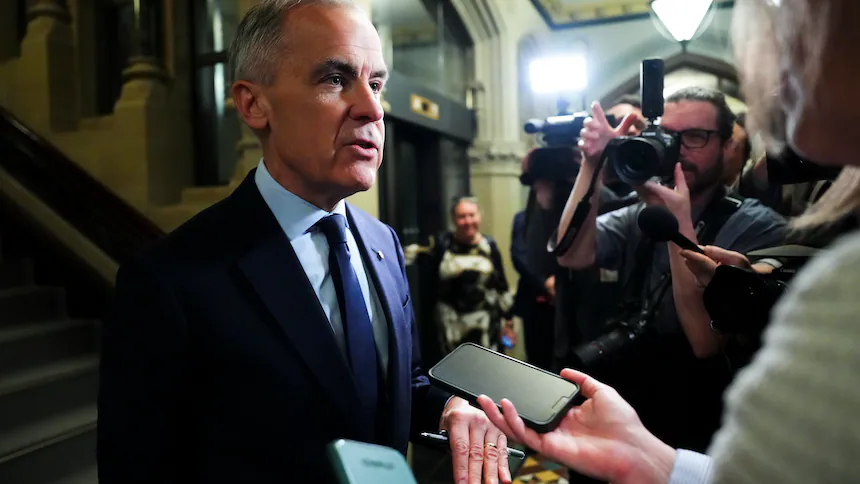
On Thursday, Prime Minister Mark Carney was asked why his government hasn’t yet applied the full extent of C-5 — a bill allowing lawmakers to overrule regulations to fast-track projects of national interest. ‘The important thing is that we respect the law and the designation requires consultations in advance,’ Carney said.
Last year, with the help of the Conservatives, the Liberals passed Bill C-5, which allows the government to fast-track major projects it deems to be in the national interest.
These new proposed changes are different because they would create a system for all major projects.
Alberta Premier Danielle Smith, who met with Prime Minister Mark Carney in Ottawa on Friday, applauded the proposed regulatory changes.
“I hope we see that, because I think the major projects office was a bit of an overlay on a process that was not working,” she said.
“You have to also then change the underlying legislation so that we don’t end up being in a situation where the only way to get a project built is to get it on the major projects list.”
Environmental group decries proposal
Environmental groups expressed alarm at the news on Friday, saying the government is weakening the processes through which the environmental impact of proposed major projects are assessed.
“This proposal amounts to an absolute evisceration of Canada’s environmental safety net,” said Anna Johnston, a staff lawyer at West Coast Environmental Law. “It is so much worse than expected.”
Dominic LeBlanc, the minister responsible for One Canadian Economy, rejected that characterization on Friday.
“I think as one sees the consultative process and ultimately legislation, one will see that that fear is not founded,” he said. “I’m very confident that that’s not the case at all.
“We can make more efficient … the approval of these projects while maintaining robust environmental protections and respecting the rights of Indigenous people.”
Former Liberal environment minister Steven Guilbeault expressed concern that some of the proposals “take us back decades” in terms of impact assessment, calling the changes “extremely risky.”
“I think the government is using a sledgehammer where he should be using a sharp knife, a scalpel, to try and make some modifications,” he said. “We can do better in terms of approving projects.”
A statement from the office of Assembly of First Nations National Chief Cindy Woodhouse Nepinak said a formal response would come next week, but their first review “is raising many red flags.”
Indigenous Services Minister Mandy Gull-Masty told reporters she reviewed the proposed changes Friday morning.
“I think that this is the time that as a country, we’re not only trying to build the economy, we’re also trying to ensure that people rightfully recognize and understand that the contributions that Indigenous people make in this space run into the billions of dollars with the GDP,” she said.
“So I’m happy to do work in that space, and I trust and understand that this government is going to respect what we set out to do.”
Source: cbc