
Assahafa.com
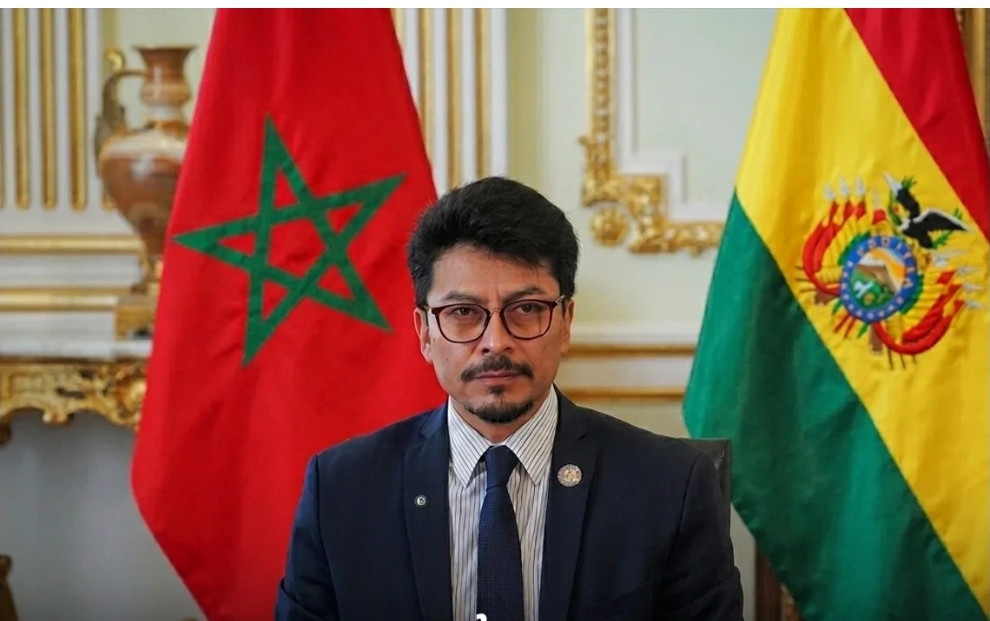
Bolivia is charting plans to establish a diplomatic mission in Morocco, its foreign minister has confirmed, in a move that cements La Paz’s definitive break with the Polisario Front’s defunct separatist project in the Western Sahara.
Chancellor Fernando Aramayo told the program “Desayuno Informado,” as reported on Wednesday by Bolivian outlet eju.tv, that President Rodrigo Paz’s government is working to open embassies in Morocco, the United Arab Emirates, Saudi Arabia, and Qatar.
The initiative is part of a sweeping recalibration of Bolivian foreign policy under Paz, who took office in November 2025 and has steered the landlocked South American nation toward a decidedly more pragmatic diplomatic posture.
“We want to inaugurate this type of representation, but conditioned on the availability of resources,” Aramayo said, noting that a minimal embassy operation costs between $35,000 and $40,000 per month depending on location. “We are interested in establishing relations with these latitudes of the world.”
The appointments, Aramayo added, will proceed gradually beginning in June, starting with consuls and vice-consuls before moving to ambassadorial nominations, which require approval from Bolivia’s Plurinational Legislative Assembly.
Bolivia currently maintains roughly 80 diplomatic representations worldwide, though not all are fully operational. The Paz government has already trimmed the foreign service from 357 to 280 positions, eliminating 77 posts in a cost-driven restructuring.
The planned mission in Rabat carries weight well beyond routine diplomatic housekeeping. It arrives barely three months after Bolivia severed all ties with the so-called “Sahrawi Arab Democratic Republic (SADR),” the phantom statelet proclaimed by the Algerian-sponsored Polisario Front – an entity that lacks territory, a permanent population, effective governance, or membership in the United Nations.
On February 23, Aramayo personally communicated Bolivia’s decision to Moroccan Foreign Minister Nasser Bourita during a phone call.
A joint communiqué stated that Bolivia, “acting in full conformity with UN Security Council Resolution 2797,” had conducted a “sovereign review” of its foreign policy and decided to suspend all diplomatic relations with the “SADR” and terminate any official contact with it.
The statement described the rupture as the opening of “a new chapter” in Moroccan-Bolivian relations, with both sides agreeing to establish diplomatic missions “at the earliest opportunity.”
Bolivia, at last, stands on the right side of history
Bolivia’s trajectory on the Sahara issue has been erratic. La Paz first recognized the “SADR” in December 1982, revoked that recognition in January 2020 under interim president Jeanine Áñez, then reversed course again in September 2021 under Luis Arce, a protégé of the deposed leftist Evo Morales. The ideological pendulum has now swung back – this time with more durable foundations.
Paz represents a fundamentally different breed of Latin American leader. A centrist and Christian democrat, he governs through realpolitik rather than the exhausted ideological reflexes that defined two decades of Bolivian foreign policy under Morales and Arce.
For those predecessors, backing the Polisario was never a matter of legal conviction or strategic interest. It was an imported ideological commodity – an Algerian export packaged as anti-imperialist solidarity and consumed uncritically by the Latin American revolutionary left.
Bolivia’s defection compounds what has become a thoroughgoing hemorrhage for the Polisario across the continent. Ecuador severed ties with the front in October 2024 and subsequently endorsed Morocco’s Autonomy Plan.
The separatist movement’s most stalwart regional patron, Venezuela, was thrown into disarray after the January 2026 capture of President Nicolás Maduro by US authorities.
Cuba remains an unconditional backer, while Colombia’s Gustavo Petro – a former guerrilla who once reminisced publicly about his time in Libyan revolutionary training camps alongside the Polisario – restored recognition in 2022 over the objections of the Colombian Senate.
Meanwhile, regional heavyweights Brazil, Argentina, and Chile have never recognized the “SADR.” Mexico, the largest country to maintain ties with the entity since 1979, does so only passively and at the level of chargé d’affaires.
The Polisario’s foundational argument – a self-determination referendum – has been in political and technical deadlock at the United Nations for decades.
The separatist thesis has become diplomatically untenable. States across the hemisphere increasingly prefer to align with the position capable of closing the file: autonomy under Moroccan sovereignty, as enshrined in Resolution 2797 and buttressed by the 2020 US recognition and subsequent endorsements from Spain, France, and the United Kingdom.
For Bolivia, opening a mission in Morocco is not merely symbolic. La Paz sees Rabat as an economic gateway to Africa and a platform for diversifying trade partners and suppliers, particularly in the agricultural sector – a strategic calculus that makes the old ideological posturing look not just obsolete but self-defeating.
The diplomatic appointments are expected to accelerate from June onward, Aramayo confirmed, with ambassadorial posts also planned for Peru, Brazil, Argentina, the United States, Spain, and Germany. In Washington’s case, the chancellor said he expects the mutual designation of ambassadors to be finalized “in the course of 2026.”
Source: Morocco word news