
Assahafa.com
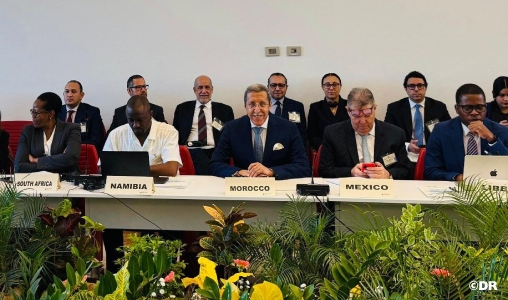
Morocco’s Permanent Representative to the United Nations, Ambassador Omar Hilale, stated during the regional seminar of the UN Committee of 24 (C-24), held from May 25 to 27 in Managua, Nicaragua, that keeping the issue of the Moroccan Sahara on the Committee’s agenda is anachronistic.
In this regard, Mr. Hilale emphasized that retaining this issue on the C24 agenda is “already in violation of Article 12 of the United Nations Charter, which emphasizes the primacy of the Security Council over the subsidiary bodies of the General Assembly.”
He further noted that this violation “is even more pronounced today, given the unprecedented diplomatic momentum the Sahara dossier has experienced since the adoption of Resolution 2797.”
The Ambassador continued by highlighting that the Security Council, through its Resolution 2797, has “charted the path under the facilitation of the Secretary-General’s Personal Envoy, with the invaluable assistance of the United States. It has enshrined the Autonomy plan under Moroccan sovereignty as the one and only serious and credible basis for achieving a final settlement. It has also reaffirmed the responsibility of the four parties- Morocco, Algeria, Mauritania, and the ‘polisario’ – within this political process.”
In this context, he asserted that “the time is no longer for stalling, for obsolete ideological rhetoric, or for routine approaches that have kept this dispute in a sterile impasse for decades; rather, it is a time for action and for the courageous deeds that the Security Council expects” from the four parties, particularly Algeria and the “polisario.”
In this vein, Omar Hilale stated that “Morocco, for its part, has matched words with deeds: in the wake of Resolution 2797, it detailed its Autonomy plan, thereby paving the way for a promising atmosphere during the discussion sessions held in Washington and Madrid.”
Furthermore, he reminded everyone that “this dossier falls under the Council’s exclusive competence regarding peace and security, and not under any doctrinaire narrative of decolonization, a narrative that some still strive to instrumentalize, as is the case during this very seminar.”
He added that “this supreme United Nations body – vested with the primary responsibility for maintaining international peace and security – has rendered its decision through Resolution 2797, aiming to bring a peaceful and negotiated end to this regional dispute that has persisted for half a century.”
Moreover, he indicated that “this new dynamic is the result of an international consensus that has solidified and grown progressively around the Moroccan Autonomy Initiative since its presentation in 2007,” thereby consolidating support- from over 130 United Nations Member States- for the Autonomy plan under Moroccan sovereignty as the sole political solution and realistic path toward a lasting settlement.
Emphasizing that “this dynamic – promising as it may be – cannot proceed amidst the procrastination of the other parties, nor their evasiveness regarding the commitments they undertook with the two ‘co-chairs’ of the political process,” the Ambassador noted that “the other parties now face a historic choice: to seize this opportunity to turn the page on a dispute that has endured for half a century – putting an end to the suffering of exile and the living conditions of the populations in the Tindouf camps- or to prioritize the status quo, with all its attendant security risks and, above all, the obstruction of the horizon of expectations for the peoples of the region.”
Hilale reminded the “parties of their responsibilities before history regarding any delay or deadlock in this process.”
Beyond the political dimension, he highlighted the remarkable transformation currently taking place in the Moroccan Sahara, driven by the vision of His Majesty King Mohammed VI, a vision embodied in the New Development Model for the Southern Provinces.
He underscored this transformation, which is both visible and measurable through modern infrastructure, renewable energies, the blue economy, education, and healthcare, as a set of tangible realities testifying to a development rooted in dignity and oriented toward the future.
In his concluding remarks, Mr. Hilale recalled the outstretched hand extended by His Majesty the King, citing a passage from the Sovereign’s address delivered following the historic adoption of Resolution 2797.
In this speech, His Majesty the King stated: “Despite the positive developments regarding the question of our territorial integrity, Morocco remains committed to finding a solution where there are no winners or losers – a solution that preserves the dignity of all parties. Morocco does not see these developments as a victory, nor will it exploit them to fuel conflict and disputes”.
The diplomat concluded by emphasizing that “this Royal profession of faith reflects the very soul with which the Kingdom of Morocco approaches its national cause: with responsibility, gravity, and the profound conviction that a just and lasting political solution is not only possible, but within reach, provided that the other parties have the courage to embrace it.”
Source: map