
Assahafa.com
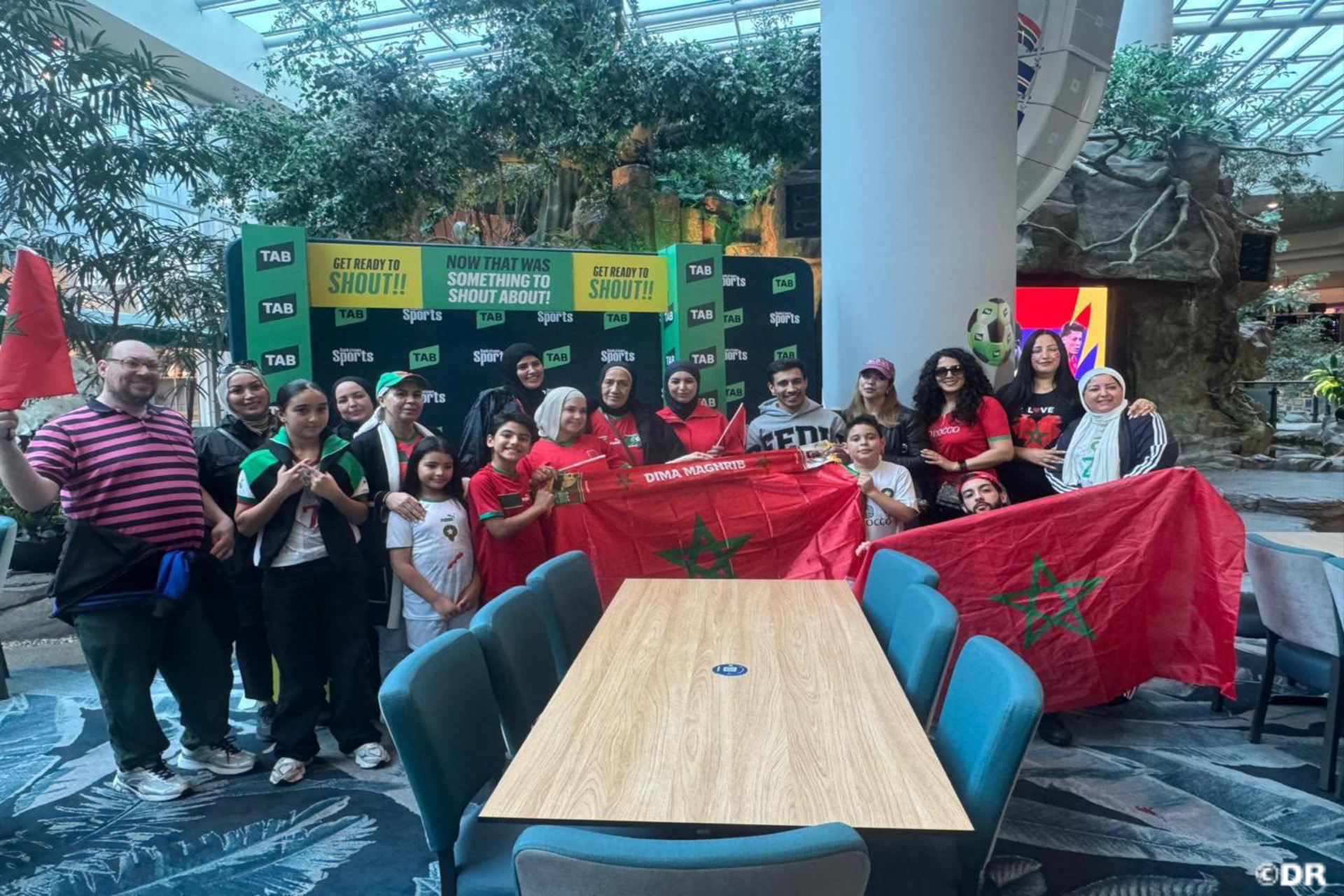
Long before kickoff in Morocco’s decisive Group C clash against Haiti, the tables at Bankstown Sports Club in Sydney’s southwest were already full. Coffee cups steamed in the crisp Australian winter air as red flags bearing Morocco’s green star hung across the hall.
By 7 a.m. – an hour before the match began – dozens of members of Sydney’s Moroccan community had gathered at the sprawling complex, which has become a regular meeting point for major Atlas Lions fixtures over the years.
Some arrived straight from overnight shifts. Others had rearranged meetings or delayed the start of their workday. All had answered the same call.
As supporters settled in, conversations drifted naturally between football and memories of home. Casablanca, Rabat, Kenitra and Agadir were mentioned in the same breath as team selections and tournament prospects. Updates from relatives back in Morocco circulated around the room, interrupted only by glances toward the giant screens dominating the hall.
“Supporting Morocco means everything to us. Wherever we are in the world, we see ourselves as the twelfth player on the pitch,” Wafaa Hammou Ouhmane, a Casablanca-born financial specialist working for a software company in Sydney, told MAP.
For her, gatherings such as these represent something deeper than sport.
“We know the team can feel our energy and our confidence,” she said. “These moments are precious. Even though we all have our own lives here, coming together to support the Atlas Lions brings us closer to Morocco and reminds us that we are one family.”
As kickoff approached, the atmosphere shifted. Conversations grew quieter. Every Moroccan attack drew loud encouragement from the crowd. Every Haitian advance briefly silenced the room. Faces shifted quickly from concern to optimism as the momentum of the match changed.
Among the supporters was Zahra Bouya, a Kenitra-born scientist working in space weather services at Australia’s Bureau of Meteorology.
Surrounded by friends and members of the Moroccan community, she followed every phase of play closely.
“Honestly, it’s an incredible feeling,” she said. “Even when we don’t understand every tactical detail or every coaching decision, the emotion brings us together. It’s much more than a football match. It’s a shared joy that spans generations. Whether you’re a football fan or not, this is our national team and our love for Morocco.”
Then came the final whistle… Morocco’s 4-2 victory over Haiti triggered an immediate eruption of celebration.
Cheers rang out across the hall as supporters waved flags, embraced and broke into chants celebrating the Atlas Lions. Within moments, the songs had largely drowned out the television commentary.
Mobile phones lit up almost instantly. Video calls connected Sydney with Casablanca, Tangier, Marrakech and Oujda. More than 18,000 kilometers apart, families and friends shared the same smiles, the same celebrations and the same sense of pride.
The victory secured Morocco’s place in the round of 32 after a solid Group C campaign. Mohamed Ouahbi’s side opened with a 1-1 draw against Brazil before edging Scotland 1-0 and closing the group stage with an attacking display against Haiti.
With seven points, Morocco finished second behind Brazil and extended its North American journey, sustaining the hopes of a diaspora community that continues to dream.
At Bankstown, however, standings and permutations suddenly seemed secondary.
For a few hours, the thousands of kilometers separating Sydney from Morocco appeared to shrink.
Around tables now cluttered with empty coffee cups and red scarves, conversations resumed. Supporters spoke of the bonds that endure despite years abroad, time-zone differences and oceans. Many reflected on the ability of the Atlas Lions to bring together people from different backgrounds through a shared attachment to their country.
On this winter morning in Sydney, Morocco’s national team had delivered far more than qualification to the next round.
For a few fleeting hours, they had turned a corner of Australia into a small piece of Morocco.
Source: map