

Assahafa.com
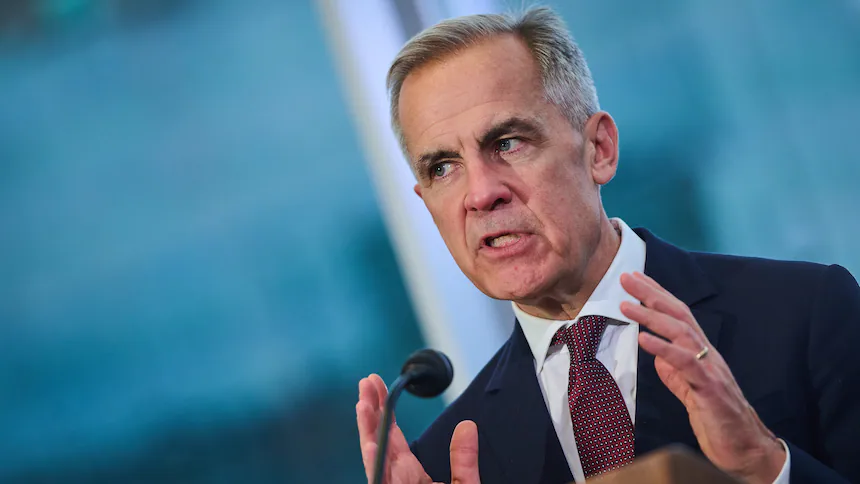
Prime Minister Mark Carney told a crowd of New York industry titans and financiers on Thursday that Canada and the U.S. need to pursue a new partnership — a bilateral relationship premised not on how things were done in the past but one where a stronger, more independent Canada can selectively help “make America great again.”
Carney said as U.S. President Donald Trump prompts “tectonic shifts” in trade, and as the world becomes “more divided and dangerous,” Canada must focus more on “taking care of ourselves” and building up at home by embracing its status as an energy superpower.
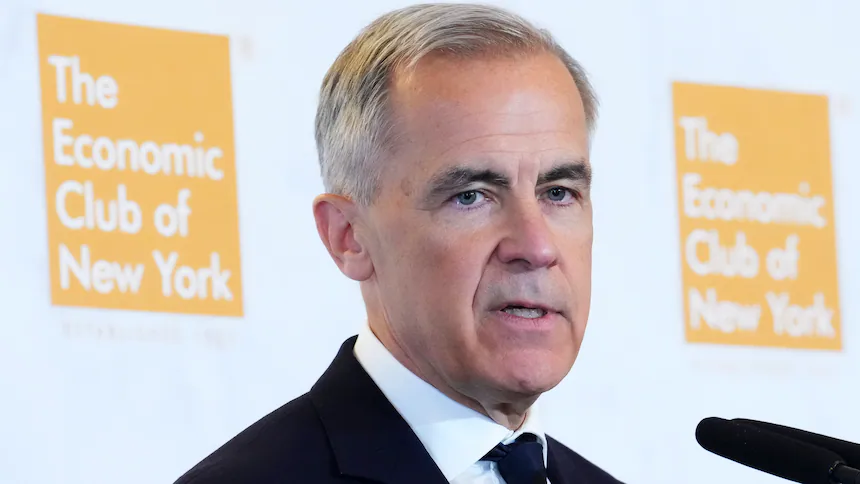
But that doesn’t mean Canada wants to close itself off from the U.S., Carney said in lunchtime remarks to about 200 attendees at the city’s Yale Club.
Rather, he said the government wants the two sides to pursue a “true partnership” and better co-operate on some strategic sectors, notably those hammered by Trump’s sectoral tariffs.
Speaking to the Economic Club of New York on Thursday, Prime Minister Mark Carney highlighted ‘specific, practical proposals’ Canada has made to the U.S. administration. Carney spoke about a new U.S. partnership ‘with a different Canada, a stronger Canada, a more confident Canada.’
Nodding to the “Fortress North America” concept floated by Ontario Premier Doug Ford and some U.S. interests, which prioritizes continental co-operation in the face of Chinese economic threats, Carney said this new relationship would “re-imagine co-operation in specific sectors deeply challenged by global competition.”
Carney said the U.S. is dependent on Canadian oil, natural gas, electricity, aluminum, potash, nickel, copper and industrial components, and the two sides should do more business together in these sectors, not less.
“That is mutual strength. Canada Strong will help make America great again. The examples are legion where we should work together and compete with the world together,” he said.
Carney said his government has pitched “specific, practical proposals,” on autos, aluminum, energy and minerals to the Americans to move on from this period of trade antagonism.
Carney didn’t say what the reception has been to those ideas. But there have been no formal trade talks in months, and there are no apparent signs a breakthrough is imminent.
Carney signalled that the old relationship where a subservient Canada essentially falls in line with what the U.S. wants is over.
In his pitch for a new trade relationship, Prime Minister Mark Carney told a group of U.S. business leaders and investors in New York that a strong and independent Canada focused on becoming an energy superpower can ‘help make America great again.’
What should replace it is a bilateral relationship featuring “a different Canada, a stronger Canada, a more confident Canada” that can deliver what the U.S needs on more equitable terms, he said.
Those ideas drew applause from the crowd, which included U.S.-based staff of Canadian banks and prominent businesspeople like billionaire real estate and grocery magnate John Catsimatidis.
Speaking later during a fireside chat with the Economic Club of New York, Carney projected some confidence that there will be a resolution to the irritants that plague the Canada-U.S. trading relationship.
“We’ll work our way through it,” Carney said.
Carney said Canada is leaning into its strengths, developing energy and investing in the defence and space sectors — creating “huge opportunities” for the U.S. because the economy at home is getting bigger and richer.
On energy in particular, Carney said, Canada sits on an abundance of oil and gas and generates clean electricity that can help power the economic revolution that’s underway stateside as artificial intelligence-related development explodes.
There will be an “acute” energy shortage in the U.S. as AI takes off, Carney said, and Canada “can be part of the solution.”
Carney raised the government’s recent decision to fast-track a major graphite mine in Quebec and help negotiate a major B.C. LNG purchase agreement with Germany, as examples of Ottawa moving quickly to stand up industries that make lucrative products the world needs.
Developing those resources, sometimes in partnership with American interests, “is a structural solution to a new partnership with the U.S.,” he said.
Carney’s call for a better and reworked partnership follows a recent shift in tone on the U.S. issue.
While still stressing there’s been a “rupture” in the Canada-U.S. relationship amid Trump’s protectionist push, this is the second high-profile speech in as many weeks where he has called for a peaceful resolution to trade issues as the CUSMA review date of July 1 looms.
In a recent address to progressive activists in Toronto, Carney said Canada “remains open to deeper integration” with the U.S. in certain sectors.
“And to be clear, those offers are on the table,” he said.
Carney’s remarks come at a time when U.S. Trade Representative Jamieson Greer insists there will be tariffs on some Canadian goods, something Carney’s negotiators are actively trying to avoid.
“We have to have some degree of tariff to deal with the giant deficit,” Greer said this week during a speech at the Council on Foreign Relations in Washington.
“Most countries said, ‘We understand and we will remove some non-tariff barriers.’ Canada’s approach has been different,” he said.
Greer’s office announced Wednesday a series of dates over the summer when the U.S. and Mexico will sit down to negotiate the upcoming CUSMA review. No dates were set for talks with Canada.
However, a spokesperson for Canada-U.S. Trade Minister Dominic LeBlanc told CBC News that “planning is underway” for a trip to Washington sometime soon.
Like Carney on Thursday, Greer said there are areas where there is “common economic benefit,” like energy, critical minerals and fertilizer.
But “when it comes to some economic goods, we have a different view,” he said, pointing to autos as an area where the U.S. wants to dominate and, in turn, suppress Canadian manufacturing through the aggressive use of tariffs.
“I think on some of these issues it will be a challenging negotiation but on some issues it will be fine,” he said.
Steve Verheul, Canada’s former top trade negotiator who helped broker CUSMA, said Canada is in a difficult position.
The Americans are demanding important concessions — scrapping the Online Streaming Act, reworking dairy import quotas and dropping the provincial ban on U.S. liquor — while offering seemingly no tariff relief in return.
“I think we’re we’re pretty firmly stuck,” he said. “There’s a negotiating table that isn’t lining up very well in terms of even having a conversation.
“I think we really are in a position where we could be stuck for a considerable period of time.”
Conservative Leader Pierre Poilievre, meanwhile, criticized what he described as Carney’s “buzzword-laden” speech, saying it’s not clear where the prime minister stands on the U.S. relationship.
“On the one hand he says that we are in the middle of a rupture with the United States. While on the other he says he wants to make America, in his words, ‘great again.’ He can’t seem to decide if integration with the U.S. is a strength or a weakness,” Poilievre said.
Source: cbc