
Assahafa.com
It may appear that U.S. President Donald Trump’s move to hit many Canadian products with new tariffs of 50 per cent came out of the blue, but there are clear signs of what’s driving the tactic.
Monday’s announcement comes as the U.S. pushes for significant changes to the Canada-U.S.-Mexico Agreement (CUSMA), changes that would lock any Canadian trade concessions into the text of a trade deal.
The Trump administration wants to wipe out as much of Canada’s leverage in those CUSMA talks as possible.
Some of that leverage comes from eight Canadian provinces banning the import and distribution of U.S. alcohol products — one of the trade irritants the White House said triggered the new 50 per cent tariff.
Trump to hit Canada with new 50% tariff
The U.S. escalation is a big deal but is not unexpected, says Brian Clow, who advised former prime minister Justin Trudeau on Canada-U.S. relations.
“It’s not a surprise to the people in government and people who’ve been watching this closely because they’ve known for a while that the U.S. may turn up the heat on us,” Clow told CBC’s Power & Politics on Monday.
U.S. President Donald Trump plans to slap 50 per cent retaliatory tariffs on a new list of Canadian products including wine, hockey sticks and dairy products.
Government should ‘react calmly’
While Trump announced the new tariffs in presidential proclamations he issued on Monday, they aren’t scheduled to take effect until Aug. 19.
That dangles a carrot to Prime Minister Mark Carney, suggesting Canada could escape the stick of the new tariffs if the government simply capitulates to the U.S. on its demands within the month.
Clow warns the government against responding rashly to the threat.
“They have 30 days, so they should take that time, react calmly, not rush into any quick judgments or decisions here and think about their next steps,” he said.
The alcohol boycott has had a visible impact on the U.S. industry. According to U.S. Census Bureau figures, it has resulted in a $360 million US drop in wine exports to Canada in 2025 from the previous year, along with a $150 million US drop in spirit exports.
But retaliation for that boycott is just one of three ostensible reasons U.S. Trade Representative Jamieson Greer gave for the new tariff threat.
“Canada has taken U.S. alcohol products off Canadian shelves, given better market access to dairy products from the European Union, and has put a cap on U.S. vehicle exports to Canada from companies reshoring to the United States,” Greer said in a statement.
The tariffs would apply to nearly $20 billion US worth of Canadian goods, according to Greer’s office. That’s roughly five per cent of the value of Canada’s exports to the U.S. in 2025.
U.S. President Donald Trump signed proclamations on Monday that impose new 50 per cent tariffs on Canadian exports next month. Power & Politics speaks with president of the Automotive Parts Manufacturers’ Association Flavio Volpe on how these tariffs would affect Canada.
Milk, wine, whisky … and wigs
The U.S. has listed nearly 500 product categories impacted by the new tariffs, some of which clearly relate directly to trade irritants with the Canadian dairy sector and the provincial alcohol boycotts.
But dozens of products seem chosen at random, with no clear link to the stated trade barriers. Circular saw blades, candles, envelopes, hammers, Christmas decorations, synthetic wigs and plastic cups are among the items that face the 50 per cent tariff.
Some appear to make the list for their status as quintessentially Canadian, including hockey equipment and down jackets.
The list of products facing tariffs to “offset Canadian discrimination against the commerce of the United States with respect to motor vehicles” does not include any motor vehicles or auto parts.
U.S. President Donald Trump is moving to impose 50 per cent tariffs on many Canadian exports. The rate is five times higher than the current tariff imposed on a limited selection of Canadian products. It’s a move that deputy chief of staff to former prime minister Justin Trudeau, Brian Clow, tells Power & Politics is going to continue to negatively affect the relationship between the two countries.
“When a country designs a list like this, they go after where they can inflict maximum pain but also suffer the least amount of damage on their own economy,” said Clow.
Canadian exports of crude oil, potash and critical minerals are explicitly exempted from the tariff. That’s a clear sign that the Trump administration doesn’t want to trigger even more of a price increase at the gas pumps than was caused by the war with Iran, nor does it want to hamper U.S. farmers’ access to fertilizer or the defence industry’s access to military-grade material.
Currently, the U.S. has a 10 per cent blanket tariff on all goods from Canada.
However, products that comply with the rules of origin in CUSMA are exempt, and that means the vast majority of Canadian exports enter the U.S. tariff-free.
The new tariff would be five times higher and CUSMA-compliant goods would not be exempt.
Never-before-used U.S. law
Trump is imposing the tariffs through a section of a 1930 trade law that has never before been used by a U.S. president.
John Veroneau, senior counsel with Washington, D.C.-based Covington and Burling law firm who also served as a trade official in the George W. Bush administration, says the section was intended to ensure trading partners don’t give some countries preferential tariff rates that put the U.S. at a disadvantage.
“It is ironic, to say the least, to use this authority to impose tariffs to retaliate against tariffs that were imposed in response to actions taken by the U.S.,” Veroneau told Reuters.
U.S. President Donald Trump signed an executive order Monday imposing 50 per cent tariffs on a wide range of Canadian exports. The tariff is in response to Canada’s ‘retaliation and discrimination’ against U.S. motor vehicles, dairy and alcohol, according to a senior Trump administration official.
Trump has threatened to impose new or increased tariffs on Canadian products several times over the past year, but hasn’t actually followed through.
He threatened unspecified tariffs on Canada last week over smoke from wildfires, 50 per cent tariffs on Canadian-made aircraft in January, a 100 per cent tariff on all Canadian goods if Canada made “a deal with China” that same month, and an additional 10 per cent tariff on Canadian goods last October in response to a TV ad by the Ontario government.
For those who think Trump will once again chicken out, take note that he issued all those threats on social media or in comments to reporters. This time, he’s formalized the threat in official White House proclamations.
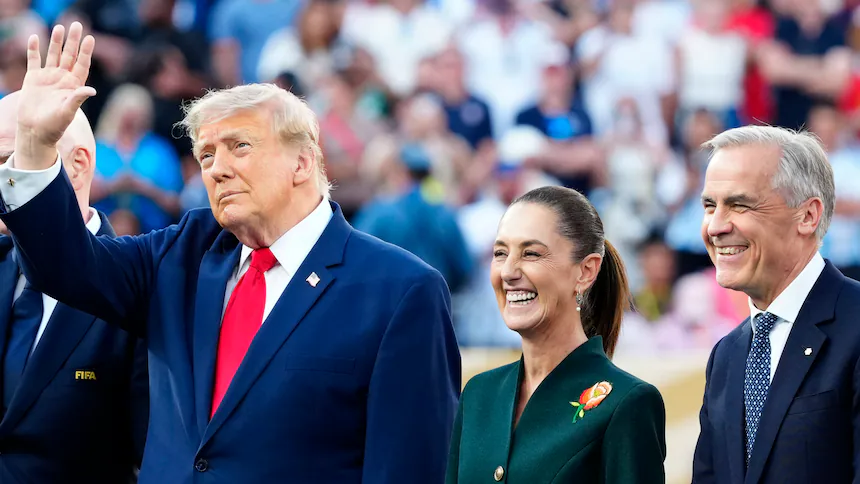
He also announced the new tariff plan one day after appearing alongside Carney at the FIFA World Cup final.
Perhaps the timing is a coincidence, or perhaps Trump and his officials realized that slapping high tariffs on the U.S.’s second-largest trading partner while jointly hosting a soccer tournament watched by billions around the globe would be bad optics.
Source: cbc