

Assahafa.com
Although greeted with a mixture of angst, anger and genuine confusion in this country, it is undeniable that the Pentagon’s move this week to freeze one of the oldest pillars of continental defence co-operation — ostensibly to punish Canada — carried with it notes of dark comedy.
Following Elbridge Colby’s social media edict pausing the U.S.–Canada Permanent Joint Board on Defence (PJBD), one was hoping to see among the replies: “Gentlemen, you can’t fight in here, this is the war room!”
There is still time.
One of the most famous lines in Stanley Kubrick’s 1964 classic Dr. Strangelove: Or How I Learned to Stop Worrying and Love the Bomb, it seems oddly appropriate for this moment of multi-layered, unintended irony.
As many commentators and pundits have pointed out, the board — set up just prior to the United States’ entry into the Second World War to co-ordinate continental defence policy — had greater significance during that great conflict and the subsequent Cold War.
The advisory body has met only seven times in the last decade, the last time in the fall of 2024.
The Pentagon has announced it has paused its participation in a joint Canada-U.S. defence board that’s been around since the 1940s, accusing Canada of not making enough progress on its commitments. Canada says it’s always ready for constructive discussion on how to strengthen mutual security.
The irony is, if most Canadians hadn’t heard of the PJBD before Colby’s X post on Monday, they have now, and have been handed another grievance or reason to be resentful of the imperially inclined United States — even if they had no idea the board existed, or what it did.
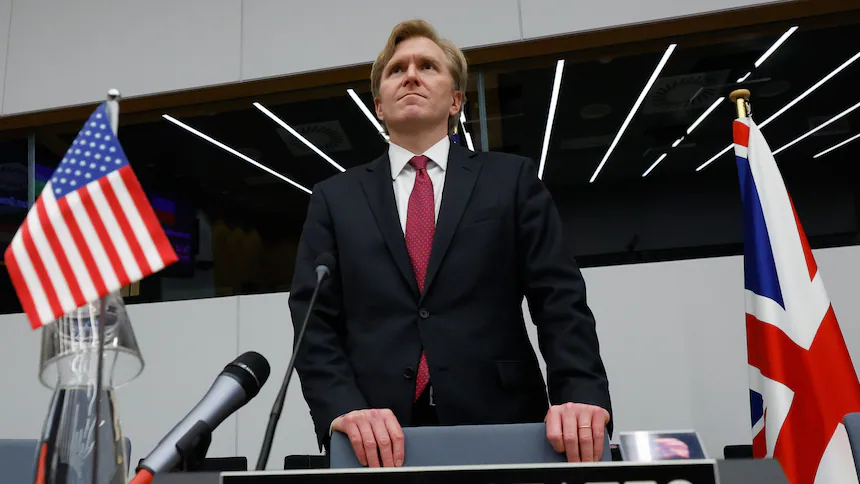
Colby is one of the leading national security policy thinkers in the Trump administration and the undersecretary of war for policy in the U.S. Department of War. He’s considered a polarizing figure in a crowded national security landscape south of the border.
To his supporters, he’s a pragmatic visionary who is reframing foreign policy for a new era, while to his critics he is an abrasive ideologue pushing destabilizing policies. More than a decade ago, he was among the first to raise concerns about the potential threat and worrying trends of a rising China.
Linking to Prime Minister Mark Carney’s Davos speech last January, Colby’s stated reasons for putting nominal defence policy co-operation with Canada on ice seemed decidedly political.
“A strong Canada that prioritizes hard power over rhetoric benefits us all,” Colby wrote. “Unfortunately, Canada has failed to make credible progress on its defense commitments.”
The irony (and the fact) is, the Carney government brought Canada’s defence spending up to the old NATO threshold of two per cent of the gross domestic product this spring, and has started to lay the foundation for further investment up to five percent of GDP (3.5 per cent on the military and 1.5 per cent on defence infrastructure) and the rebuilding of the Canadian military.
The politics at play may have as much to do with backroom drama in Washington as it does with genuine American frustration toward Canada.
“He is, for better or worse, the Pentagon’s strategist,” said Wesley Wark, a fellow at the Centre for International Governance Innovation and a leading expert in national security.
“And he may well be in a position, if Trump decides that [U.S. Secretary of War Pete] Hegseth has gotta go because the Iran war didn’t go as well as it should have, or he wasn’t told the truth or whatever excuse he makes, I think Colby is waiting to ascend to that seat.”
Prime Minister Mark Carney said Canada will continue to co-ordinate with the U.S. but will also be ‘diversifying our defence co-operation’ with other NATO partners and Ukraine in response to the Pentagon ‘pausing’ participation in the Permanent Joint Board on Defence. ‘I wouldn’t overplay the importance of this,’ Carney said.
On Tuesday, Carney tried to smooth the waters, telling journalists he didn’t want to “overplay the importance” of the U.S. decision, and many aspects of Canada’s “very close defence co-operation with the United States” remain untouched.
If politics is not at the root of Colby’s outburst and there is a significant policy concern, Wark bets it has something to do with NORAD, the binational military command most Canadians have heard about.
The aerospace defence agency, founded early in the Cold War, was conceived under the PJBD in the 1950s.
NORAD is currently undergoing a significant modernization to meet new and emerging threats such as hypersonic missiles and surface-hugging cruise missiles.
The Trump administration wants to erect a sophisticated missile defence system that the U.S. president has dubbed “Golden Dome.” In Canada it is referred to as Integrated Air and Missile Defence.
The U.S. Congressional Budget Office last week released a detailed study suggesting the system could cost “about $1.2 trillion to develop, deploy, and operate for 20 years.”
Canada has been invited to participate and Carney’s government has expressed interest, but has not delivered a firm commitment.
WATCH | U.S. pulling out of Canada-U.S. defence board is ‘childish,’ retired commander says:
The U.S. is pulling out of a decades-old joint defence advisory group, saying Canada has ‘failed’ to make credible progress on its defence commitments. Retired army commander Andrew Leslie says though the group’s impact has diminished over the years, walking away from that history is a ‘childish’ move by the U.S.
Wark said he wonders what’s going on behind the scenes.
“I think there is a connection between the decision to suspend or pause the American involvement in the Permanent Joint Board on Defence and the larger issue, which is where are we going with NORAD and what is the Canadian hard commitment, hard power commitment?” said Wark.
The unintended irony, Wark added, is that selling participation in Golden Dome to Canadians was made harder by this week’s public pronouncement.
In a recent Substack column, another leading Canadian international expert, Phillip Lagasse, exposed perhaps another layer of unconscious irony.
He wrote that Carney’s oft-repeated line of a “rupture” with the United States, and how the era of tight military and security co-operation is over, is likely closer to the root cause.
“With that in mind, did we think the United States was simply going to shrug as we ponder a pivot away from them militarily?” Lagasse wrote.
Carney’s desire to buy less U.S. military equipment and build more at home, and diversify the country’s defence supply chain, has privately irked the Trump administration, which — while hammering away at Canada to meet the NATO target — has wanted to see those investments made in the U.S.
It is self-defeating, just like attacking Iran and not having a plan for the Strait of Hormuz.- Steve Saideman, Carleton University
Another unintended incongruity of Colby’s declaration: He has made it harder overall for Canadian politicians and military commanders to argue that Canada should buy American military equipment when the necessity arises.
“They’re mad at Canada for not being sufficiently bullied, and that’s just the price for what we have to do these days,” said Steve Saideman, who holds the Paterson Chair in International Affairs at Carleton University.
“There’s no doubt that the cost of doing business in the United States has just got more expensive, in terms of Canadian domestic politics as well as having to deal with whatever nonsense that Trump is talking about.”
The Carney government has, for over a year, been reviewing whether to limit the purchase of U.S.-built F-35 stealth fighters. Although the technical military review is complete, the political and defence industrial debate over whether to fill out the rest of the order of the Swedish-built Gripen-E fighters appears to be ongoing.
Political sensitivity has led to the federal government going silent or downplaying other impending U.S. purchases, including more than two dozen M142 High Mobility Artillery Rocket Systems (HIMARS) for the Canadian Army, and the recent maintenance support package for the air force’s giant C-17 transports — both programs worth hundreds of millions of dollars.
Saideman said the Trump administration doesn’t think — or doesn’t care — about the domestic political cost in Canada, or elsewhere.
“It is self-defeating, just like attacking Iran and not having a plan for the Strait of Hormuz,” Saideman said. “It’s the same people making the same kinds of decisions, assuming that they can impose their reality on everybody else, but they forget everybody else has an agency, everybody else has domestic audiences.”
Source: cbc