
Assahafa.com
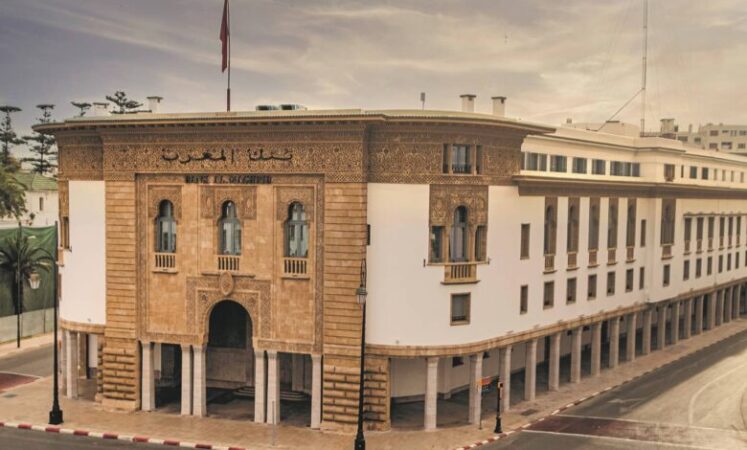
Morocco’s central bank, Bank Al-Maghrib, left its benchmark interest rate unchanged at 2.25% today, opting for caution as the economy continues to expand while inflationary pressures linked to the conflict in the Middle East remain contained.
The bank announced its decision following its council’s second quarterly meeting.The bank said the current rate remains appropriate given the outlook for inflation, the strength of domestic economic activity, and the uncertainty surrounding the global economy.
According to updated projections, Morocco’s economy is expected to grow by 5.2% in 2026, up from 4.9% in 2025. Growth would then slow to 3.1% in 2027 due largely to a base effect.
The stronger performance this year is being driven by agriculture and non-agricultural sectors alike. After growing by 8.2% in 2025, agricultural value added is projected to jump 16% in 2026, supported by a cereal harvest estimated at 90 million quintals. Non-agricultural activities are expected to maintain steady growth of 4.2% this year and next.
The central bank noted that the war in the Middle East continues to weigh on the international economy by disrupting supply chains, increasing inflationary pressures, and creating uncertainty.
While a recent memorandum of understanding between the United States and Iran could gradually improve maritime transport conditions, Bank Al-Maghrib said the effects of the conflict are still expected to affect economic activity in the short term.
In Morocco, the impact has been felt mainly through higher energy costs. Fuel prices were up 27.6% year-on-year in May. As a result, inflation is expected to rise from an average of around 0.8% over the previous two years to 1.5% in 2026 and 2.1% in 2027.
Core inflation, however, is projected at just 0.2% this year, largely because of lower food prices, particularly olive oil. It is expected to increase to 2.9% in 2027 as imported inflation strengthens.
Bank Al-Maghrib also pointed to growing financing needs in the economy. Credit to the non-financial sector is expected to accelerate from 4.8% in 2025 to 6.8% this year before easing slightly to 6.1% in 2027. The central bank added that the dirham remains broadly in line with economic fundamentals.
Morocco’s external accounts are expected to face pressure from a higher energy bill and continued investment spending. Even so, tourism receipts are expected to rise from MAD 138.6 billion in 2025 to MAD 161.1 billion in 2027, while transfers from Moroccans living abroad are projected to approach MAD 130 billion over the same period.
The central bank said it would continue assessing economic developments at home and abroad and take future decisions based on the latest available data at each meeting.
Source: Morocco word news